Head-to-Head: Macbook Pro 14 2021 vs Macbook Neo A18 Pro 2026 (Detailed Comparison)
Introduction
The MacBook lineup has long represented the gold standard for professionals, creatives, and everyday users seeking reliable performance, premium design, and a robust ecosystem. With the launch of the Macbook Neo A18 Pro in 2026, Apple has once again redefined expectations for portable computing, raising the question: how does this next-generation powerhouse stack up against the widely acclaimed Macbook Pro 14 from 2021? This comprehensive comparison dives deep into the design, performance, features, and usability of these two pivotal devices, equipping readers with expert insights to make an informed choice.
Product Overview
Macbook Pro 14 (2021)
Announced at Apple’s October 2021 “Unleashed” event, the Macbook Pro 14 immediately set a new standard for professional laptops. Reintroducing a broader set of ports, the revered MagSafe charger, and featuring the breakthrough M1 Pro and M1 Max chipsets, the Macbook Pro 14 offered not just raw power, but tailored the experience for creative professionals. Its Mini-LED Liquid Retina XDR display, stellar battery life, and robust thermal management created a nearly unrivaled productivity companion.
Macbook Neo A18 Pro (2026)
The Macbook Neo A18 Pro, debuting in 2026, encapsulates Apple's foray into the “Neo” era of computing, marked by the integration of the revolutionary Apple Silicon A18 Pro chip on a 2nm process. This model also boasts an edge-to-edge Adaptive OLED display, significant advances in AI-based workflows, enhanced connectivity, and even further optimizations in battery performance and thermal efficiency. Lighter, thinner, and smarter, the Neo A18 Pro targets power users, content creators, and those who demand the absolute latest in mobile computing.
Feature-by-Feature Analysis
| Specification | Macbook Pro 14 (2021) | Macbook Neo A18 Pro (2026) |
|---|---|---|
| Processor (CPU) | Apple M1 Pro or M1 Max (5nm) | Apple A18 Pro (2nm) |
| Display | 14.2" Liquid Retina XDR, 3024 × 1964, 120Hz | 14.5" Adaptive OLED, 3280 × 2160, 144Hz, ProMotion Ultra |
| RAM | 16GB–64GB Unified Memory | 32GB–128GB Unified LPDDR6X Memory |
| Storage | 512GB–4TB SSD | 1TB–8TB NVMe Gen5 SSD |
| Ports | HDMI, SDXC, 3×Thunderbolt 4, MagSafe 3, 3.5mm | 2×Thunderbolt 5, 2×USB4, MagSafe 4, eSIM, 3.5mm |
| Graphics | M1 Pro/Max Integrated GPU (up to 32 cores) | A18 Pro Custom Neural GPU (up to 48 cores) |
| Battery Life | Up to 17 hours (typical use) | Up to 22 hours (typical use) |
| Weight | 3.5 lbs (1.6 kg) | 2.92 lbs (1.32 kg) |
| Operating System | macOS Monterey (upgradable) | macOS Neo (2026 release) |
| Webcam | 1080p FaceTime HD | 1440p AI-Powered Center Stage Pro |
| Connectivity | Wi-Fi 6, Bluetooth 5.0 | Wi-Fi 7, Bluetooth 5.4, 5G Ready (eSIM) |
| Biometrics | Touch ID | Face ID, Touch ID 2.0 |
Detailed Analysis
Design & Build Quality
The 2021 Macbook Pro 14 was celebrated for its return to a more functional chassis, reintroducing MagSafe and useful ports while maintaining a robust, premium feel. The all-metal enclosure, improved thermals, and the focused, pro-oriented design meant it was built to last both functionally and esthetically.
The Neo A18 Pro, by contrast, embodies Apple's latest design language: a near bezel-less frame, an even more compact profile, and a chassis that is both lighter and stronger thanks to an advanced aluminum-titanium alloy. The hinge is smoother, the keyboard's haptics are improved, and the trackpad now offers Adaptive Touch, morphing subtly based on the in-app context.
Display Technology
The Pro 14’s Liquid Retina XDR display was a revelation in its time, offering brilliant brightness, color accuracy, and high refresh rates. Mini-LED allowed for deeper blacks and high contrast, crucial for photo and video work. However, the Neo A18 Pro’s Adaptive OLED not only expands the color gamut and contrast ratio further but introduces ProMotion Ultra, scaling refresh rates up to 144Hz. The Neo also brings Always-On capabilities, touch input, and a peak brightness that outshines its predecessor.

Performance: CPU, GPU, and AI
Apple made waves with the M1 Pro and M1 Max, enabling desktop-grade editing, compiling, and 3D workflows on battery power. For creative professionals—video editors, developers, scientists—the Pro 14 provided a transformative performance jump.
Find top-rated Laptops & Computers products at great prices.
Shop Amazon →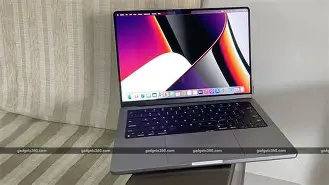
Five years on, the A18 Pro’s 2nm process multiplies efficiency and power. Real-time 8K editing, simultaneous AI-powered tasks (like background separation, live upscaling, and AR), and on-device machine learning are dramatically accelerated. The custom Neural GPU boosts workloads like 3D rendering, app simulations, and scientific computations. In short, the Neo enables workflows that were previously reserved for desktop-class devices.
Memory & Storage
The Pro 14’s unified memory, starting at 16GB, kept everyday and pro tasks snappy and allowed impressive multitasking. Storage options topped out at a massive 4TB SSD. In contrast, the Neo’s adoption of LPDDR6X Unified Memory (up to 128GB) and ultra-fast Gen5 NVMe storage (up to 8TB) mean larger datasets, bigger projects, and heavier multitasking are now routine. This is invaluable for AI researchers, video professionals, and power users handling gigantic files on the go.
Ports & Connectivity
A major draw for the Pro 14’s audience was the reintroduction of practical ports: HDMI, SDXC, and MagSafe, which eliminated the reliance on dongles. Thunderbolt 4 guaranteed speedy peripheral and external GPU support.
The Neo A18 Pro shifts to Thunderbolt 5 and USB4, enabling mind-bending external display and transfer speeds. Although the SD slot and HDMI are dropped, expansion is still well served for creative workflows, especially with the addition of native 5G (via eSIM), Wi-Fi 7 readiness, and a next-generation MagSafe 4.
Battery Life and Thermals
The Pro 14’s stellar battery life (up to 17 hours) let users leave chargers behind for most of the day. The efficient thermal system kept the device cool and nearly silent even under load. The Neo A18 Pro goes further, promising up to 22 hours of mixed use and rapid charging. Improved thermal compounds, smarter AI-based fan control, and silicon efficiencies mean sustained, throttling-free performance—even with demanding workflows.
Next-Gen Features: AI, Biometrics, and More
The Pro 14 introduced an upgraded FaceTime HD camera (1080p) and reliably quick Touch ID. The Neo A18 Pro leverages an AI-powered Center Stage Pro webcam, Face ID with infrared sensors, Touch ID 2.0 for instant authentication, context-aware microphone arrays, and per-app haptic feedback.
Shop the latest Laptops & Computers picks on Amazon.
Browse Now →On the software front, macOS Neo is more deeply integrated with iCloud, on-device machine learning, and offers advanced privacy features and native AR support—expanding creative and productivity possibilities.
Pros & Cons
Macbook Pro 14 (2021)
- Pros:
- Outstanding performance for its era (M1 Pro/Max chipsets)
- Mini-LED XDR display; superb color accuracy
- Wide array of ports (including HDMI, SDXC)
- Excellent build quality and keyboard/trackpad
- Strong battery life, quiet thermals
- Well-supported in macOS ecosystem
- Cons:
- Heavier and thicker than newer models
- FaceTime camera and biometrics less advanced
- No adaptive refresh or touch input
- More basic AI capabilities compared to Neo
- Maximum RAM/storage less than 2026 models
Macbook Neo A18 Pro (2026)
- Pros:
- Cutting-edge 2nm Apple Silicon (A18 Pro) delivers unmatched performance and efficiency
- Stunning Adaptive OLED, ProMotion Ultra, near bezel-less design
- Ultra-lightweight, premium build with improved haptics
- Next-gen connectivity (Wi-Fi 7, native 5G, eSIM)
- AI-driven features: camera, workflow accelerations, contextual haptics
- Face ID and Touch ID 2.0 for fast, secure authentication
- Extended battery life and even quieter thermals
- Cons:
- Premium pricing exceeds older models
- No HDMI or SDXC slot—potential inconvenience for legacy peripherals
- Software/app compatibility best with latest releases
- Accessory ecosystem (e.g., MagSafe 4, TB5) still catching up in 2026
Buying Guide: Choosing the Right MacBook for Your Needs
Selecting a Macbook is never just about numbers—it's about matching the device to authentic real-world use cases. Here’s how buyers can prioritize:
Who Should Choose the Macbook Pro 14 (2021)?
- Budget-Conscious Power Users: With the arrival of newer models, the Pro 14 can often be found at substantial discounts (refurbished or new-old-stock). It still offers formidable processing for students, content creators, and developers who do not require bleeding-edge features.
- Legacy Workflow Compatibility: Users needing HDMI out, an SD card slot, and tried-and-true USB-C/Thunderbolt 4 for cameras and peripherals will appreciate the Pro 14’s port selection.
- Stable macOS Support: The Pro 14 continues to receive updates and security patches, ensuring longevity and smooth integration in educational or business environments.
Who Should Choose the Macbook Neo A18 Pro (2026)?
- Early Adopters / Innovation Seekers: Those who want the absolute latest in Apple’s silicon, display tech, and AI integration will find the Neo A18 Pro near-future proof.
- Pro Creators & Developers: Real-time 8K/AR/VR editing, advanced AI workloads, or simulation-heavy applications see substantial gains. The huge memory ceiling and ultrafast SSDs support intensive multitasking and large-scale projects.
- Road Warriors & Travelers: Lighter weight, extended battery life, and native eSIM 5G support make the Neo A18 Pro perfect for those who demand top-tier portability without compromise.
- Security & Privacy Focused: Enhanced Face ID, advanced secure enclave, and on-device private AI features provide peace of mind for business professionals and privacy-conscious users.
Other Factors to Consider
- Accessory Ecosystem: If you rely on existing docks or accessories, check for compatibility with Thunderbolt 5 and MagSafe 4 (adapters may be needed for Neo purchasers).
- Software Support: While the Neo A18 Pro delivers superior technology, some legacy software may run best on Monterey or Ventura-based platforms with M1 hardware. Check with vendors for macOS Neo compatibility.
- Resale Value: Apple laptops tend to hold their value, but newer models typically see less depreciation over the first few years compared to older releases.
Conclusion
Both the Macbook Pro 14 (2021) and the Macbook Neo A18 Pro (2026) stand as testaments to Apple’s commitment to innovation, longevity, and user-focused design. The Pro 14's proven performance, reliability, and practical connectivity continue to make it a solid choice, especially for those with established workflows or budget constraints. However, the Neo A18 Pro sets a new bar for what is possible in mobile computing, integrating future-ready AI, faster silicon, and a sophisticated design that’s built for tomorrow’s creative, professional, and mobile demands.
Ultimately, selecting between these two classics is a matter of prioritizing which features—performance, display, portability, connectivity, or cost—best align with your specific needs. In either case, users will find themselves equipped with a powerful, elegant productivity companion that delivers hallmark Apple value.